THE WEST AFRICAN EXAMINATIONS COUNCIL GHANA
Basic Education Certificate Examination
Integrated Science 2005
OBJECTIVE TEST
Objective Test
Question 1
Question 2
Question 3
Question 4
Question 5
Question 6
Question 7
Question 8
Question 9
Question 10
Question 11
Question 12
Question 13
Question 14
Question 15
Question 16
Question 17
Question 18
Question 19
Question 20
Question 21
Question 22
Question 23
Question 24
Question 25
Question 26
Question 27
Question 28
Question 29
Question 30
Question 31
Question 32
Question 33
Question 34
Question 35
Question 36
Question 37
Question 38
Question 39
Question 40
THEORY
ESSAY
This paper is in two sections, A and B Answer Question 1 in Section A and any other three questions in Section B. Credit will be given for clarity of expression and orderly presentation of material
Question 1

- In an experiment, a pupil took two empty Milo tins and made holes in their sides as shown in the diagram above.The pupil then filled the Milo tins with water. Draw and label the diagrams to show what the pupil will observe in set-up A and set-up B Explain the observations in set-up A and set-up B What is the aim of set-up A? What is the aim of set-up B?
- In an experiment, equal volumes of dilute hydrochloric acid (solution A) and dilute sodium hydroxide (solution B) are mixed together to form solution C. What is the volume of solution C? Red litmus paper and blue litmus paper are dipped in turns into solutions A, B, and C. State the observations you will make in all six cases. Give the name of the reaction that took place between solution A and solution B. Identify solution C. State what will happen when solution C is heated.
- The table below gives the steps that were followed in an experiment to test for starch in a green leaf freshly taken from a tree. Stages in the Test for Starch I. Leaf is put into boiling water for 1 minute II. Leaf is dipped in alcohol warmed in a hot water bath III. Leaf is washed in cold water IV. Leaf is dipped into iodine solution State the reason for carrying out each of the activities in stages I, II, and III. What happens when the leaf is dipped in iodine solution? Give the colour changes of the leaf from the beginning of the experiment to the end of the experiment. Why is the alcohol warmed indirectly in a water bath? Explain what will be observed if the test is carried out on a leaf taken from a plant kept in a dark room for 1 day.
PART I [40 marks]
Answer all of Question 1
Questions for this section are in the printed paper.
PART II [45 marks]
Answer anythreequestions from this section
Question 1
(a) (i) Define respiration. (ii) Give two differences between photosynthesis and respiration. (b) (i) List the chemicals used in the preparation of carbon dioxide in the laboratory (ii) How would you test for carbon dioxide in the laboratory? (c) (i) State four effects of a force on a body. (ii) A horizontal force of 250 N is applied to pull a piece of wood lying on a smooth surface through a distance of 20 m. Calculate the work done.
Question 2
(a) (i) Give two differences between a vein and an artery. (ii) State two functions of red blood cells. (iii) Mention two diseases associated with the circulatory system. (b) (i) Classify the following processes into a physical change and a chemical change: Cooking of food; Melting of candle; Melting of ice; Rusting of iron; Dissolution of sugar in water; Burning of wood into ash. (ii) Explain the basis of the classification in (b)(i). (c) (i) State the laws of reflection. (ii) Draw a ray diagram of light incident at an angle of 40o on the surface of a plane mirror.
Question 3

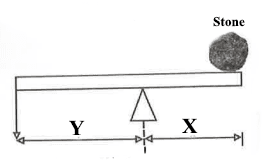
(a) (i) Explain vegetative reproduction (ii) State two differences between sexual reproduction and vegetative reproduction. (iii) Give one advantage of vegetative reproduction. (b) (i) Name suitable solvents for the following substances: oil paint, fat, common salt, plant pigments. (ii) What is the name given to a substance dissolved by a solvent? (c) The diagram below represent a simple machine. (i) What class of simple machine does it represent? (ii) Name the parts labelled I, II and III (iii) Give two examples of machines used in everyday life which work on the same principle as the system illustrate above.
Question 4
(a) (i) Give two differences between a parasite and a vector. (ii) Write down the names of three endo-parasites and their hosts. (b) An atom has eight protons and nine neutrons. (i) Draw the atomic structure of the atom. (ii) If the atom gains two extra electrons what will be the charge of the ion formed? (Show working) (c) (i) Three insoluble liquids X, Y and Z are shaken together in a bottle and allowed to settle. The densities of the liquids are as follows: X = 1.5 g/cm3 Y = 3.0 g/cm3 Z = 1.0 g/cm3 Draw a sketch to show the various layers into which the liquids settle. (ii) The density of petrol is 0.9 g/cm3. Calculate the volume of 300 g of petrol.