THE WEST AFRICAN EXAMINATIONS COUNCIL GHANA
Basic Education Certificate Examination
Integrated Science 2004
OBJECTIVE TEST
Objective Test
Question 1
Question 2
Question 3
Question 4
Question 5
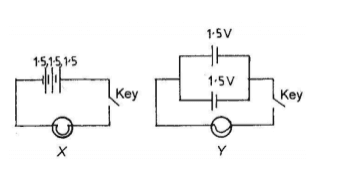
Question 6
Question 7
Question 8
Question 9
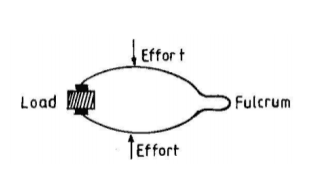
Question 10
Question 11
Question 12
Question 13
Question 14
Question 15
Question 16
Question 17
Question 18
Question 19
Question 20
Question 21
Question 22
Question 23
Question 24
Question 25
Question 26
Question 27
Question 28
Question 29
Question 30
Question 31
Question 32
Question 33
Question 34
Question 35
Question 36
Question 37
Question 38
Question 39
Question 40
THEORY
ESSAY
This paper is in two sections, A and B Answer Question 1 in Section A and any other three questions in Section B. Credit will be given for clarity of expression and orderly presentation of material
Question 1

- Study the simple circuit diagram shown below and answer the questions that follow. Identify the components labelled I, II, III, IV, V and VI Which component is used to close the circuit? State the observation that will be made when the circuit is closed. State the energy transformations that take place when the circuit is closed. Give the name of the circuit connection between components IV and VI.
- The diagram below is an illustration of an experimental set-up used for separating a mixture of water and alcohol. Study the diagram carefully and answer the questions that follow. State the method of separation shown in the set-up. Identify liquid Y, with reasons. Give the functions of the thermometer and the water jacket X. What physical processes are involved in the method of separating the mixture? State the physical property which makes it possible to separate the water and alcohol.
- A student performed tests on food substances A, B and C and made the following observations Food Substance Test Observation A Few drops of iodine solution was added to A The iodine solution turns blue-black B A drop of B was applied to a white sheet of paper A translucent patch was seen on the paper C Benedict's solution was added to C and the mixture boiled Benedict's solution turns from blue to brick-red Identify food substances A, B and C. Give the products of digestion of A, B and C. In which parts of the alimentary canal does the digestion of each of food substances A, B and C start? In which part of the alimentary canal is food substance C absorbed after digestion?
PART I [40 marks]
Answer all of Question 1
Questions for this section are in the printed paper.
PART II [45 marks]
Answer anythreequestions from this section
Question 1
(a) (i) List four parts of a plant that are used for asexual reproduction (ii) Give two reasons why sexual reproduction is more advantageous than asexual reproduction. (b) (i) Explain why atoms are electrically neutral (ii) Write the systematic names of the following substances: (α) CuO, (β) SO2 [5 marks] (c) (i) What is dispersion of light? (ii) Draw and label a diagram of dispersion of light through a triangular glass prism. [4 marks]
Question 2
(a) (i) What is soil erosion? (ii) Give two types of soil erosion. (b) Write the name and chemical formula of the compounds formed when the following elements combine: ( i) zinc and oxygen (ii) calcium and chlorine (c) (i) Distinguish between heat and temperature. (ii) Draw and label the mercury-in-glass thermometer. (iii) What mode of heat transfer is involved in the use of a thermometer?
Question 3
(a)(i)What is a hormone? (ii)Copy and complete the following table.
Question 4
5. (a) (i) Distinguish between a rhizome and a stem tuber (ii) Give one example each of a rhizome and a stem tuber [5 marks] (b) State the method which could be used to separate each of the following mixtures and explain your answer in each case: (i) salt and water, (ii) sawdust andiron filings, (iii) powdered charcoal and water [6 marks] (c) (i) Define density of a substance (ii) Explain how a body which sinks in water could be made to float. [4 marks]